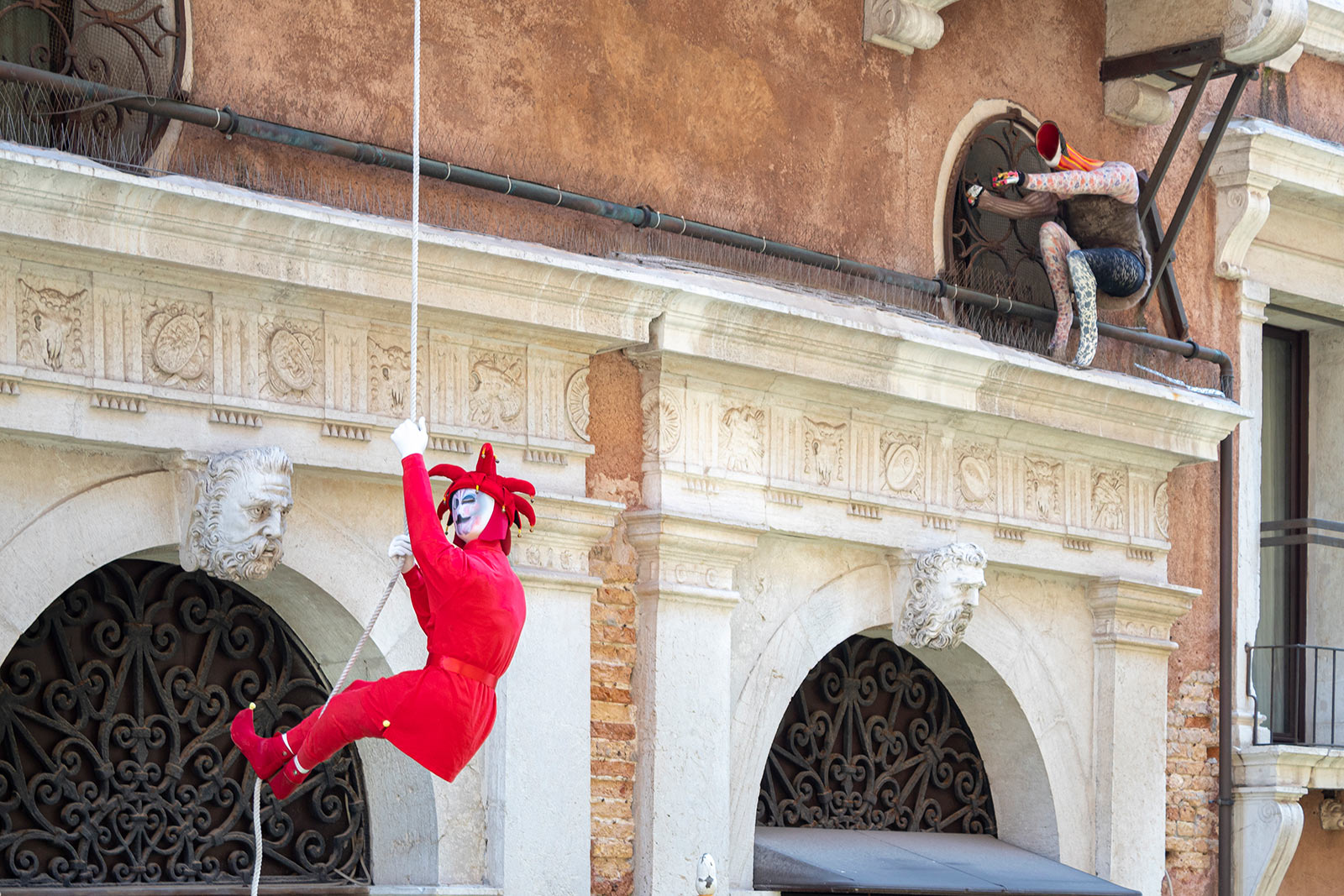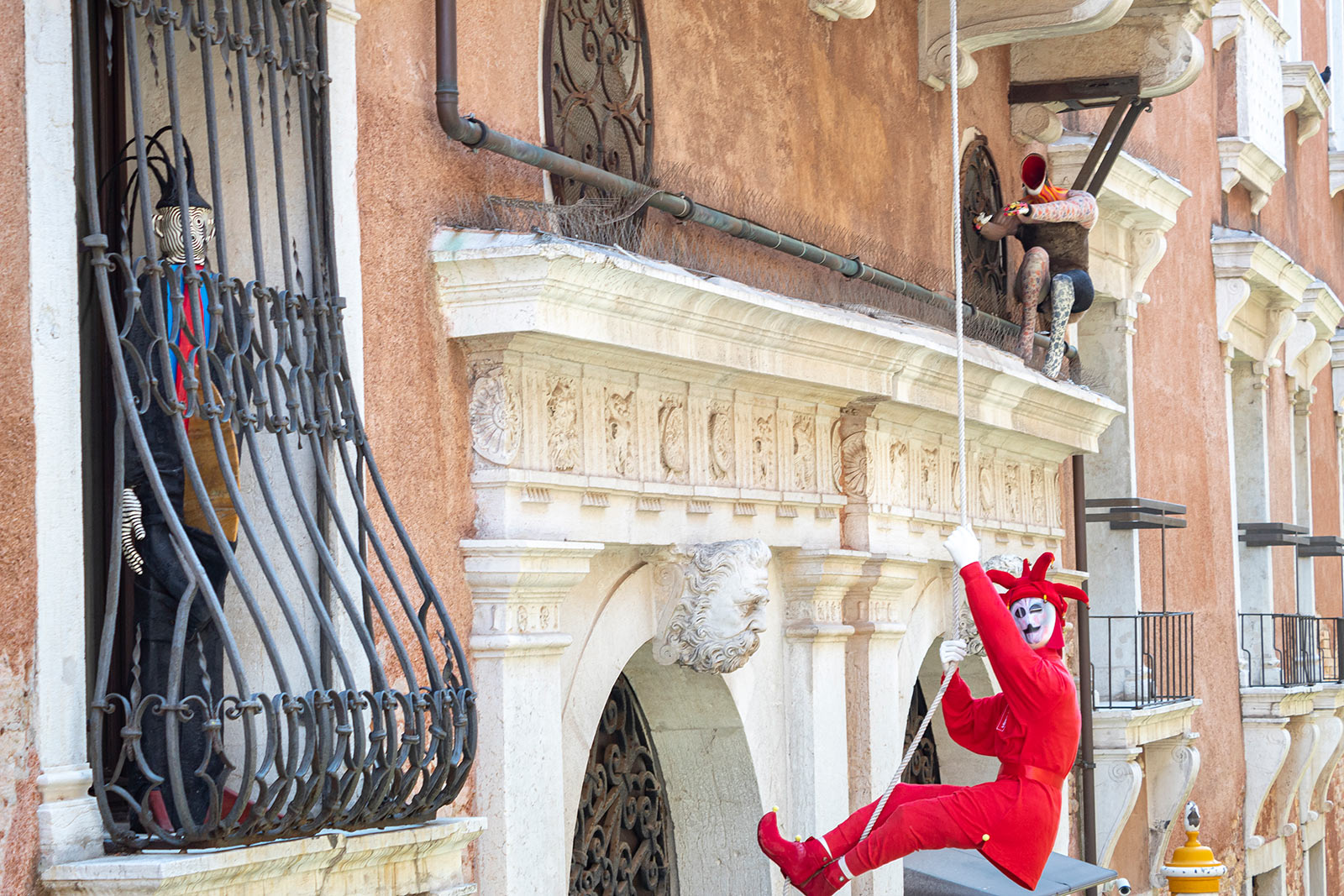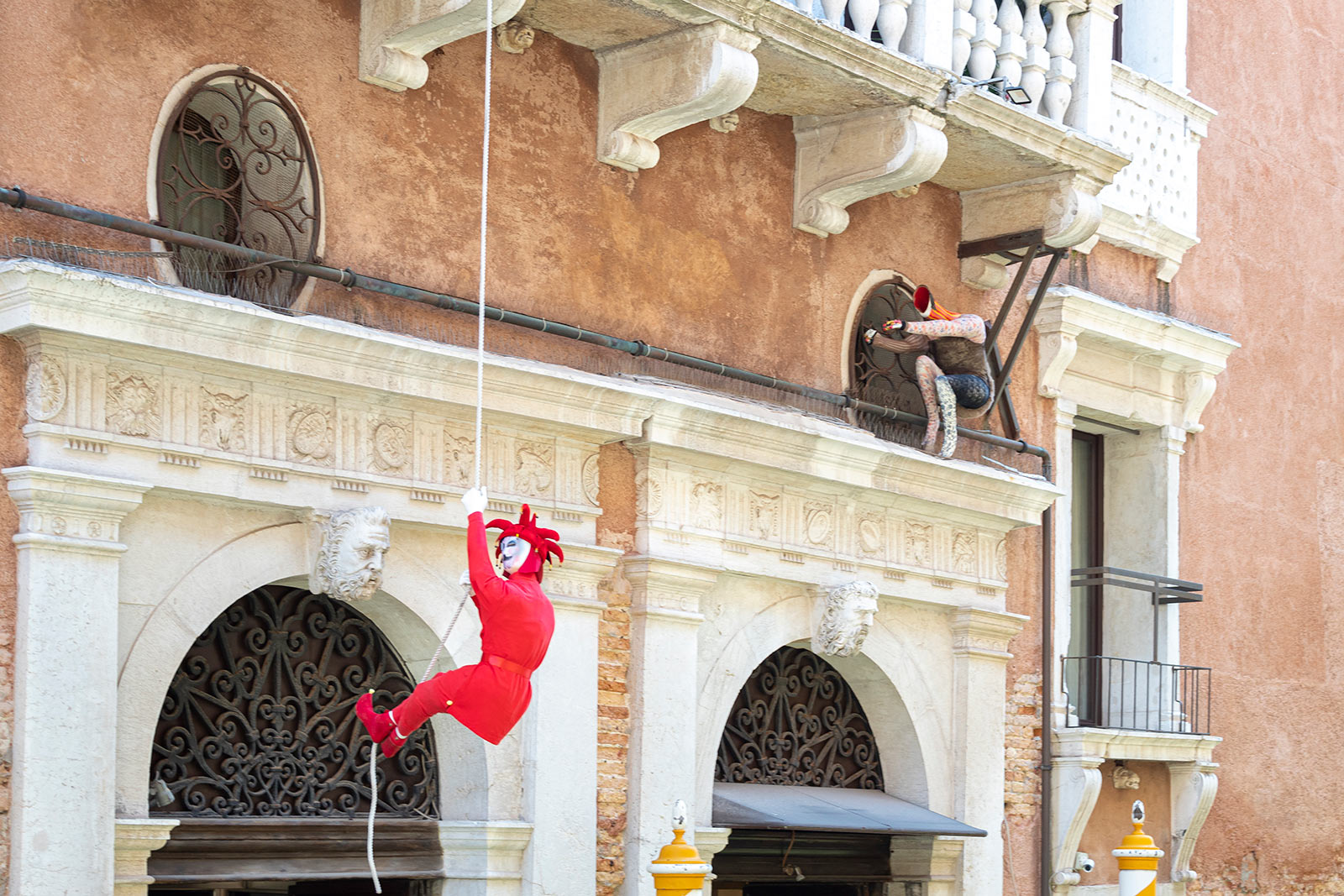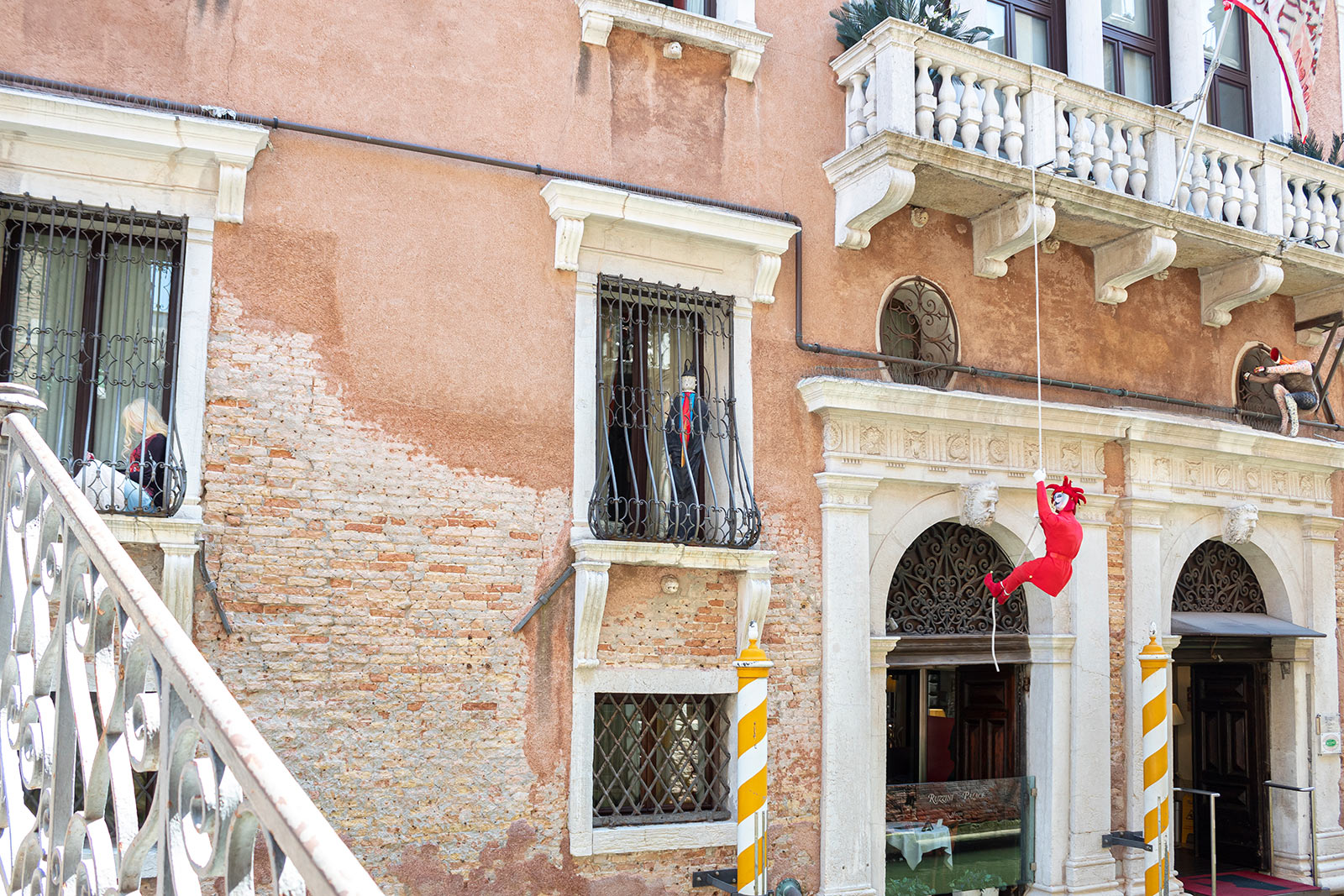

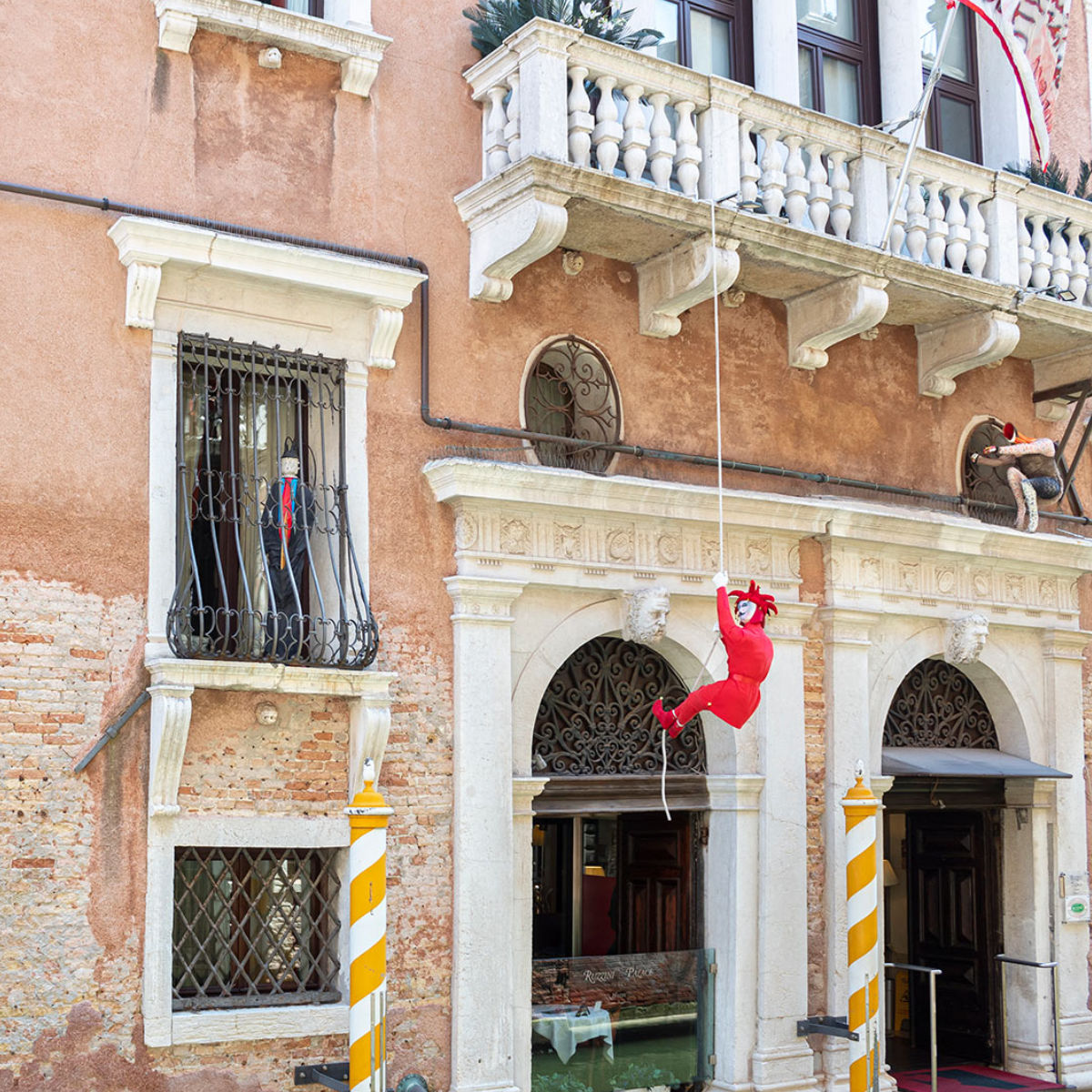
In the silence of a Venetian calle, behind the Ruzzini Palace Hotel, the original installation “Solitudine di ragazza, in falsa compagnia” evolves into a powerful sculptural triptych through the introduction of two new figures: a “Folletto” and a “Real ghost”. The work thus moves beyond a reflection on digital alienation to become a clinical and existential theatre of the human mind.
At the centre of the work sits the girl, absorbed in the simulacrum of a smartphone: a “false companionship” of notifications that progressively anaesthetises her identity. Her iridescent, featureless face becomes a phenomenological void in which passers-by are invited to see their own alienation reflected. The iron grating that separates her from the outside world thus assumes an ambivalent nature: it protects her while, at the same time, imprisoning her.
It is within this condition of digital passivity that the work’s two unconscious extensions emerge. Above her looms the Real ghost, a sinister alter ego and personification of the Shadow: a presence that condenses repressed anxieties and appears to assail the subject from the outside, while intimately belonging to her own psychic dimension.
As its counterpoint, the Folletto appears. It is here that the work radically subverts historical and folkloric tradition. Far removed from the classical iconography of the mischievous, unpredictable or ambiguous creature, the Folletto is reinvented as a profoundly positive figure, closer to the spiritual purity of an elf.
It becomes the girl’s benevolent guardian, an allied presence capable of intervening at moments of greatest crisis to restore control, slowing down or interrupting the destructive action of the Real ghost.
Within the conflict between these presences, what might be described as a magical organisation of mental equilibrium begins to take shape. The psyche generates the ghost, a disturbing force capable of shaking it from its torpor through anguish, while simultaneously activating the Folletto as a principle of defence, preventing that same anguish from ultimately overwhelming it.
Yet this inner dynamic remains a terrain of uncertainty: the two unconscious extensions offer no guarantee that they will fulfil the mission for which the psyche has generated them. The endemic struggle between the ghost and the Folletto risks becoming chronic, turning into a permanent short circuit that leaves the girl hostage to her own paralysis.
It is at this point that the work anticipates its decisive twist, scheduled for September. The introduction of one final work will break the stasis with the force of a revelation: a transformative presence that, through the eruption of its universal energy, intervenes directly in the equation: Nichel!
Moving beyond the boundaries of individual psychodynamic conflict, this transcendent force redeems the passivity and apathy generated by the almost eschatological condition in which the girl finds herself, breaking the hypnotic spell of the simulacrum.
“Solitudine di ragazza, in falsa compagnia” ultimately finds its completion in the gaze of those who pass by. From the individual condition of the seated figure, the question shifts towards the viewer, transforming the Venetian calle into a space of confrontation with the self: how alone are we, really, when we believe ourselves to be in company?